
Showing posts with label G321 Thriller research. Show all posts
Showing posts with label G321 Thriller research. Show all posts
Tuesday, 25 January 2011


Wednesday, 8 December 2010
Witness
The opening scene is of a young Amish boy who travels to Philadelphia Station on the train for the first time. The young boy finds himself trapped in a toilet cubicle whilst a murder of a police officer takes place, he is the only witness.
The opening shot of the murder scene is an extremely high angled, point of view (from the statue!) shot looking down at the boy in the station. This instantly gives an eerie feel
like a great force is watching over the young boy. Even though the boy is obviously

looking at the statue, it foreshadows the events of the rest of the scene. It's almost like a CCTV shot which Witnesses the events in the train station, which is ironic as the boy is the one who witnesses a murder.

This is a shot of the boy in the toilets of the station. This plays on the audience's fear of confined space and becoming trapped especially with a murder going on outside the toilets as the audience are unsure if he is in danger or not. Tension.
The murder is carried out by a black man which stereotypically represents black/american men as criminals. This is a zeitgeist and represents the mood of the moment in america as there was a lot of gang related knife crime, a majority carried out by black young men.
Thursday, 25 November 2010
The Sixth Sense
The Scene in which Dr. Malcolm Crowe is shot by one of his ex patients in his own home uses many camera techniques which connotate various aspects of the thriller genre. With it being the most important scene in the film (even though this is unknown until the very end of the film) the director needs to keep the audience on their seats and want to keep watching.


The scene starts with a medium shot of Anna Crowe. The light is noir in order to add mystery to the beginning of the scene, not giving away too much to the audience, heightening the tension. The chiaroscuro lighting (non ambient) is casting a shadow behind her, connotating and hinting that there is someone else around whom the audience, and characters within the mise-en-scene do not know about, adding the fear of uncertainty amongst the audience. This extreme of lighting is highlighting her face, showing the raw fear and emotion, worrying the audience that something is wrong. A zoom shot is used to show broken plates on the floor. The camera is uneven and wobbly showing that this is a point of view shot from Malcom as he walks towards the mess on the floor, the effect of doing this is to make the audience feel involved as although they know that the camera is meant to be Malcom, they feel it could also be themselves and they feel the emotion and fear that he would feel.


This shot shows Anna screaming. The low lighting makes the shot seem like a nightmare and her and Malcom are inprisioned inside it. The fact that the audience now know there is something there, makes them feel even more on edge, yet still making them want to keep watching. The effect of shooting this inside their home plays on the fear of clautraphobia again because they are trapped inside the room and even thoigh there is a window next to them, we know they cannot escape as they are upstairs. It also makes the scene ironic because people normally feel safe in their own homes and this privacy and safety has been invaded; causing more fear amoungst the audience as they know it could happen to them too. The director has still not given away who is there, still building up the suspense and fear amounst the audience (and characters).
The camera pans around quickly, towards the source of the shadow.

The camera pans around quickly, towards the source of the shadow.
It is hinted that the intruder is inside the bathroom by using the rule of thirds to centre the focal point drawing the eye to the door, which is framing the fear within the shot. The use of the light is ironic as usually light means safety, however, in this case, it is bringing 'light' showing the audience who the intruder is, heightening fear once again as they perhaps do not want to know any more. The effect of using a door way is to once again build tension as the door is acting as as a hideaway for the intruder, the audience will be on the edge of their seats are they are unsure of what is going to happen, whether the camera will zoom closer; revealing the person or whether the suspense will build more, still not giving away their identity. The area within in the door, using ambient lighting (as it is within the mise-en-scene), is much brighter than the area around, giving a sense of detachment from the rest of the shot. However, this is unusual as normally it is the area in which the source of the fear is coming from, that is darker than the rest of the shot.
 A close up of Malcom and Anna's faces are used in response to the shot of the door. This shows the raw emotion and fear on their faces causing the audience to empathise with them. Empathy is important with the audience as people who watch films engage with the films much better if they can relate to the characters. In the shot, Malcom is is front of Anna, showing that he is in charge; the domineering character. In thrillers, the woman character is often either the hero; femme fatale, such as the Bride in Kill Bill, or she is the victim. From this, the audience gather that Anna is the victim, because of the camera angle. It is making her look small, and like she is hiding behind her husband, keeping the audience involved as they will be feeling her fear. The light of the door is also casting a square area of light on Anna, almost as if to 'frame' her as the victim. This is ironic, as later it is revealed that Anna actually was not the victim.
 The camera zoomed slowly, towards the door, mimicking the way that Malcom would move towards the bathroom, showing the fear in his movements. This shot still not does reveil the identity of the inruder, only showing his clothes on the floor and his legs, once again building on the tension and curiosity of the audience. The fact that his clothes are on the floor makes the audience wonder what has happened and why the man isn't wearing them. The light is still dark in order to not give too much away, similarily with the fairly long shot, making sure the audience cannot identify anything about the man.
 The identity of the intruder is given away and the camera cuts to this close up of Malcom's face giving the audience a feel of the shock and emotion Malcom is feeling. He is obviously scared, resulting in the audience also feeling his fear. This reflects on the audience more so as a few shots ago, he was the character who was seen to take charge, which is often the case with male characters.


Wednesday, 17 November 2010
Opening of Alfred Hitchcock's Strangers on a Train
The opening of Strangers on a Train is very gripping, and a rather unusual beginning to a thriller film. Hitchcock is famous for his variety of shots connotating aspects of the thriller genre.
 It starts by the camera focusing on two different taxis pulling up at a train station. Two men come out of the taxis and the camera (low angled) focuses on their feet, cutting from one person to the other. This uses the 180degree rule as it always shoots the feet from the same side, suggesting that they are going to meet. This could also connote the belief in 'fate' and 'everything happens for a reason' perhaps suggesting that something bad is going to happen.
The two men's shoes are very different so you can tell the difference between the two of then. The first man that walks about of the taxi has very expensive looking shoes perhaps showing that he is richer and more authoritative than the second man who wears plainer, yet still smart shoes, showing that he is also probably a business man or fairly high up in a company, yet not as much so as the first man. The fact that the man with the black and white, more expensive shoes steps out and is shown first, also suggests he is higher up than the other man.
Up until the moment they step on the train, the audience do not see their faces at all in the opening sequence, this gives a sense of mystery and builds up the tension amongst the audience leaving them wondering who they people are and what importance they have and most of all.. what is going to happen. This sense of uncertainty is essential in gripping the audience, keeping them in their seats.
The camera shots cut very quickly from one man to another, this gives the opening scene pace, which it needs to keep the audience gripped. The quickness also connotates urgency and would seem to make the audience panicky and feel like they are watching the two men and anticipating them meeting. Tuesday, 16 November 2010
Thorne: sleepyhead
"Sleepyhead is a nail-biting thriller following DI Tom Thorne's investigation into a mysterious serial killer. His first three victims ended up dead. His fourth was not so fortunate. Alison Willetts is unlucky to be alive. She has survived a stroke, deliberately induced by skilful manipulation of pressure points on the head and neck. She can see, hear and feel, she is aware of everything going on around her, but she is completely unable to move or communicate. It's called Locked-In Syndrome. In leaving Alison Willetts alive, the police believe the killer's made his first mistake.
D. I. Tom Thorne (David Morrissey) discovers the horrifying truth: it isn't Alison who is the mistake, it's the three women already dead and Thorne knows that they are unlikely to be the last. For the killer seems to be getting his kicks out of toying with Thorne as much as he is pursuing his sick fantasy. Thorne must find a man whose agenda is terrifyingly unique, and Alison, the one person who holds the key to the killer's identity, is unable to tell anybody.
Scaredy Cat will see David Morrissey, Eddie Marsan and Aidan Gillen reprising their roles in an adaptation of Billingham's second DI Tom Thorne thriller, where killing becomes a team sport. The film depicts a vicious, calculated murder. The killer selected his victim at Euston station, followed her home on the tube, and strangled her to death in front of her child. At the same time, killed in the same way, a second body is discovered at the back of King's Cross station. It is a grisly coincidence that eerily echoes the murder of two other women, stabbed to death months before on the same day. Thorne discovers that this is not a single serial killer he's up against, but two of them."
D. I. Tom Thorne (David Morrissey) discovers the horrifying truth: it isn't Alison who is the mistake, it's the three women already dead and Thorne knows that they are unlikely to be the last. For the killer seems to be getting his kicks out of toying with Thorne as much as he is pursuing his sick fantasy. Thorne must find a man whose agenda is terrifyingly unique, and Alison, the one person who holds the key to the killer's identity, is unable to tell anybody.
Scaredy Cat will see David Morrissey, Eddie Marsan and Aidan Gillen reprising their roles in an adaptation of Billingham's second DI Tom Thorne thriller, where killing becomes a team sport. The film depicts a vicious, calculated murder. The killer selected his victim at Euston station, followed her home on the tube, and strangled her to death in front of her child. At the same time, killed in the same way, a second body is discovered at the back of King's Cross station. It is a grisly coincidence that eerily echoes the murder of two other women, stabbed to death months before on the same day. Thorne discovers that this is not a single serial killer he's up against, but two of them."
Sky 1's review on Thorne; Sleepyhead

D.I Tom Thorne; a flawed hero:
Tom Thorne is a flawed hero, or arguably a loved villain as he shoots a man who killed his three daughters, making it look like suicide. No one found out that he did this until the last episode where the murderer Thorne was investigating, wrote in blood of his victim; 'How did it feel when you killed him Tom?'. The effect of giving a flawed hero (however, not to this extent) is giving the audience a character in which they can relate to. It's easy for a producer to feed the audience a hero which never does wrong, however it takes more skill, and is much more gripping for the people watching to have a character which they all know isn't perfect. The fact that he isn't perfect makes him seem more realistic as everyone- no matter how good they may seem- have faults. The fact that he is also in the police give s a more complicated, darker feel to the series which could arguably be compared to the series of 'Life on Mars' and 'Ashes to Ashes' with character Tom Thorne much resembling the flawed hero Gene Hunt.
 s a more complicated, darker feel to the series which could arguably be compared to the series of 'Life on Mars' and 'Ashes to Ashes' with character Tom Thorne much resembling the flawed hero Gene Hunt.
 Stills from the series:
Low angled shot of Tom Thorne making him seem important as the audience are 'looking up to him' as the hero of the shot. This still is using the rule of thirds directly drawing the audience's attention to him as the main focus of the shot.
The lighting is ambient using the sun to light the shot, giving an effect of it being natural and the scene not 'set up'. The location however, is very typical of Thriller films or television series as it is run-down and seemingly isolated with the corrugated iron acting as a wall which plays on the audience's fear of being trapped inside, allowing them to feel involved and empathise with the character. Claustrophobia is also playing on making the audience feel uncomfortable as they are unaware of who may be behind the camera and it gives them a fear of not being able to run away and escape. The location is also run down with the graffiti and scrap bits of iron falling away, this gives the effect of there having been crime before which makes the audience think it could happen again. 
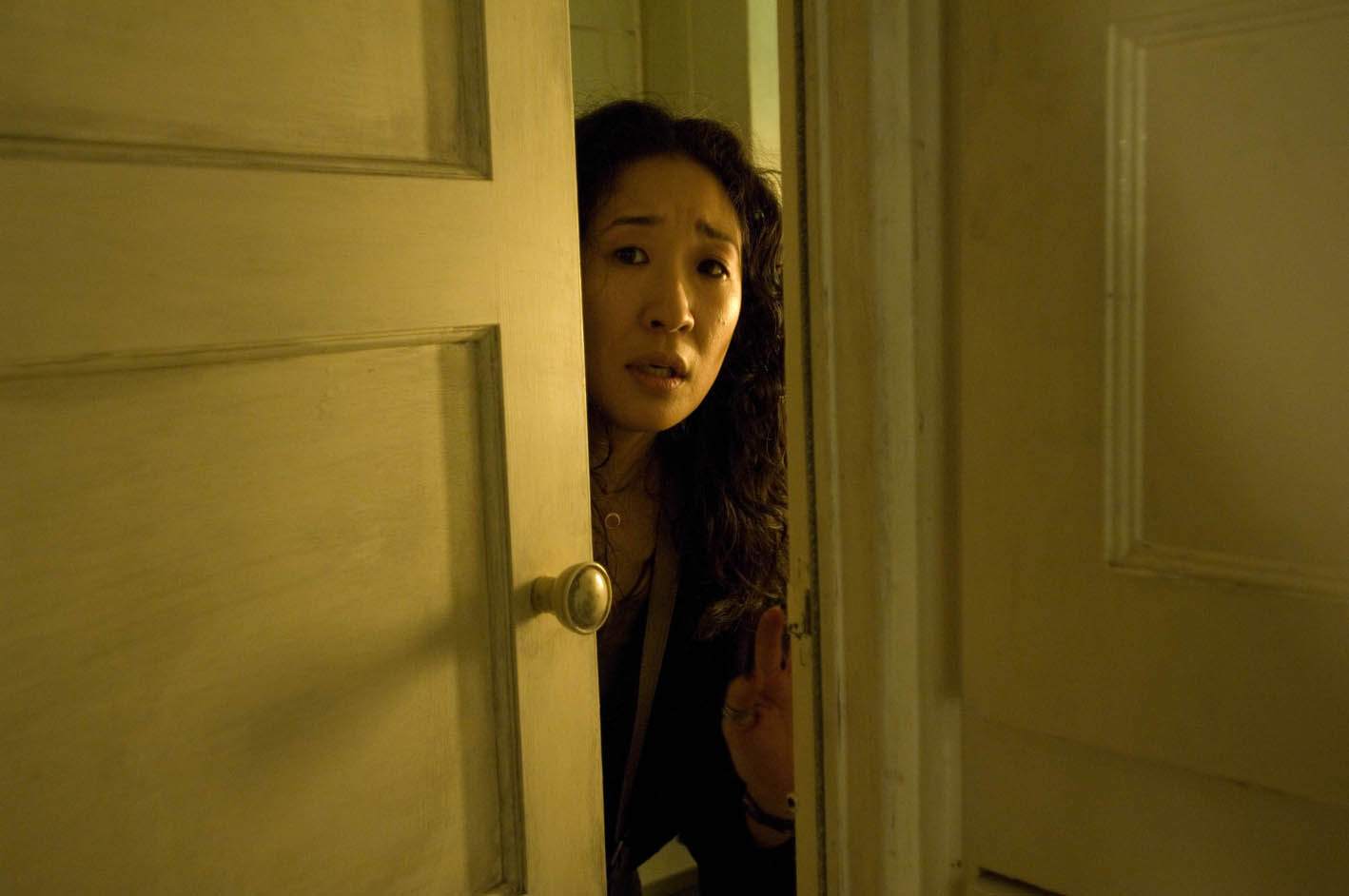
Once again this is playing on the fear of being trapped, as she clearly is, yet also using the door for protection.
Tuesday, 2 November 2010
The Third Man 1949 Carol Read
The opening shot is that of a Zither, this is a cultural signifier as it is an Austrian instrument which is where the film is set. It is also used as Harry limes is good at pulling people's strings.
 The audience are finally introduced to the setting of the film; Vienna- the capital city of Austria. Various stills from Vienna inform the audience of the context of the film shoiwng a once grand city, now a fragmented bomb site also telling them about the black market from during and after the war and already an element of darkness and mystery has been introduced upon the film. Suddenly a different wave of emotion is brought into the film with a photograph of a half sunken ship, surrounded by ice with the remains of the destroyed, once thriving, capital city in the background. A dead body, floats in the water. Only a minute in and already connotates of a thriller are uses through the sad sight of what is left of the second world war, destroyed buildings and destroyed people.
 The camera cuts to a low angled shot of a steam train which is silhouetted against the extremely light background. The low angled shot makes the train look massive compared to the background. The train brings Holly Martins, a friend of Harry Limes, into the scene. He steps off the train wearing a trilby hat and trench coat with steam from the train covering his face- classic costume of the 1940's noir thrillers. The use of a train pulling in to a station is often used in thrillers as it is mysterious and builds tension as we are unsure of who is about the step off the train, or who is going to be meeting our character. The person stepping off the train is often vulnerable as most of the time they are entering a place they are unsure of, such as our character here; Holly Martins. A long shot is taken of him walking through the streets of Vienna, almost as if someone were watching him from a distance. The camera cuts to a long shot of him him walking under a ladder which is foreshadowing, because it is suggested that something bad is going to happen to him. He is seen walking up the stairs and we see a fantast
The Sewer Scene is one of the most famous scenes from a film ever. It is iconic because of the varieties of different shots and the fact that it was actually shot in the infamous Vienna sewers. The effect used by using the sewers is showing how Harry Limes used the sewers in order to move from the different parts of the city, occupied by the different Superpowers, labelling him a 'sewer rat'. He did this by going underground and moving along the dirty, wet sewers. With the filming in black and white, this makes the wet clobbles stand out more causing a 'nightmare' effect.

 Tarantino uses this is Kill Bill volume two when the bride manages to free herself from the grave and the camera (much like the one used in the Third man) takes a low angled shot of her hands. The music in this scene in Kill Bill 2 is the same as from The Good, Bad and the Ugly, meaning Tarantino has devoloped his scene from referencing two others.

A majority of the shots filmed in The Third Man are tilted, this connotates the way Harry Limes life isn't straight forward, it's tilted and doesn't make sense, it shows him as not being perfect.

 The audience are finally introduced to the setting of the film; Vienna- the capital city of Austria. Various stills from Vienna inform the audience of the context of the film shoiwng a once grand city, now a fragmented bomb site also telling them about the black market from during and after the war and already an element of darkness and mystery has been introduced upon the film. Suddenly a different wave of emotion is brought into the film with a photograph of a half sunken ship, surrounded by ice with the remains of the destroyed, once thriving, capital city in the background. A dead body, floats in the water. Only a minute in and already connotates of a thriller are uses through the sad sight of what is left of the second world war, destroyed buildings and destroyed people.
  The camera cuts to a low angled shot of a steam train which is silhouetted against the extremely light background. The low angled shot makes the train look massive compared to the background. The train brings Holly Martins, a friend of Harry Limes, into the scene. He steps off the train wearing a trilby hat and trench coat with steam from the train covering his face- classic costume of the 1940's noir thrillers. The use of a train pulling in to a station is often used in thrillers as it is mysterious and builds tension as we are unsure of who is about the step off the train, or who is going to be meeting our character. The person stepping off the train is often vulnerable as most of the time they are entering a place they are unsure of, such as our character here; Holly Martins. A long shot is taken of him walking through the streets of Vienna, almost as if someone were watching him from a distance. The camera cuts to a long shot of him him walking under a ladder which is foreshadowing, because it is suggested that something bad is going to happen to him. He is seen walking up the stairs and we see a fantast
ic high angled shot on a stairway looking down to Martins, as if from the perspective of the Austrian man he is talking to. A looming shadow is cast behind him causing a sense a mystery and fear. The man is talking in Austrian/German and there are no subtitles, meaning the audience do not understand what is being said, connotating he way Holly Martins is unsure of what is happening. The high angled shot has been used to show Holly as being vulnerable making the audience feel un-easy.
The Sewer Scene is one of the most famous scenes from a film ever. It is iconic because of the varieties of different shots and the fact that it was actually shot in the infamous Vienna sewers.


Towards the end, Harry Limes is shot and suddenly the tables are turned as he becomes the vunerable one. A high angled shot looking down at Harry Limes is taken as he is dragging himself up a spiral staircase, this makes him look small and in danger. The effect of suddenly showing the villain is this vunerable light is allowing the audience to feel empathy with him. Harry Limes is seen as a loveable villain because the audience does not see him throughout the films until the very end meaning they cannot form an opinion of him.
Intertextuality:

When Harry limes reaches the top of the stairs, the camera takes a low-angled show of his hands, showing them as bigger than they would normally appear connotating a nightmare.

A majority of the shots filmed in The Third Man are tilted, this connotates the way Harry Limes life isn't straight forward, it's tilted and doesn't make sense, it shows him as not being perfect.

Saturday, 30 October 2010
Once Upon a Time in America
Straight away on the opening of Once Upon a Time in America, the audience is shown nothing but a black screen and God Bless America playing in the background. This is ironic as the film is actually critisising America and it's corrupt system.
 The first character seen is a woman and instantly the audience see connotations of a classic Femme Fatal with the pearls (which are often assosiated with pureness and wealth. However, the mother of pearl is also assosiated with death), 1930's/40's hat and red nails and lips. Red lipstick is assosiated with glamour and is seen as a sensual colour to be worn. We then see her obvious beauty as she turns on a light. All the action is in the dark so far, a convention used in thrillers to connotate mystery and nightmare.
 the camera pans to a high angle shot of the bed as if from Eve's point of view. The tension builds as the audience see her pull back and reveal the outline of a body, made with bullet holes. They are instantly put on edge because of the uncertainty of who is around, This fear is then made real as the viewers hear a gun shot. The camera (a point of view shot, as if it were the woman) then turns around to reveal three men, all wearing long trench coats, typical of spies, or detectives.They instantly know they are villians as they have guns, it plays on our mind that perhaps these are the men who put the bullet holes in her bed. This is dramatic irony as the audience know that something is about to happen.
 They then interregate her of the whereabouts of a man, whom we can only assume to be her partner or husband. When she tells them she doesn't know, they appear to become angered and impatient with her. We see an over the shoulder shot from
 behind the woman as she is talking to the three detectives/police men. The men realise they are going to get no information from her and one pulls out a gun, shooting her in the chest- perhaps to prevent her telling anyone the conversation she had just had with them. The shot showing her dead uses rule of thirds with her lying across the bottom horizontal line and then men connotating the vertical lines. They are almost framed against the doorway.


 the camera pans to a high angle shot of the bed as if from Eve's point of view. The tension builds as the audience see her pull back and reveal the outline of a body, made with bullet holes. They are instantly put on edge because of the uncertainty of who is around, This fear is then made real as the viewers hear a gun shot. The camera (a point of view shot, as if it were the woman) then turns around to reveal three men, all wearing long trench coats, typical of spies, or detectives.They instantly know they are villians as they have guns, it plays on our mind that perhaps these are the men who put the bullet holes in her bed. This is dramatic irony as the audience know that something is about to happen.
 behind the woman as she is talking to the three detectives/police men. The men realise they are going to get no information from her and one pulls out a gun, shooting her in the chest- perhaps to prevent her telling anyone the conversation she had just had with them. The shot showing her dead uses rule of thirds with her lying across the bottom horizontal line and then men connotating the vertical lines. They are almost framed against the doorway.
 The action then seems to die down the audience enter an Opium den, this is where Noodles (the person the policemen interrogated Eve about) is hiding. The sequence in the Opium Den reflects the decadence of the era, the lifestyle of Noodles who is a flawed hero, whilst providing a link between the flashback and the action.The atmosphere is very chilled (I wonder why?!) which gives a refreshing break from the somewhat rushed and edgy tension of the action so far. We see Noodles lying down and the sound of a phone rings. This is both diagetic and non diagetic as it is in his head, so we hear it, although it is not directly within the mise-en-scene. The noise of the phone causes agitation. Noodles has a flashback, and the ringing is a sound bridge, which anticipates reaction. In his flashback, go to go a scene where three men are lying dead on a wet cobbled street, there is fire in the background giving a sense of hell to the shot.

Friday, 15 October 2010
Essex Boys

Essex boys is a British film produced in the year 2000, it's directed by Terry Winsor
Straight away upon the opening of Essex Boys, we see conventions of a Thriller with the teenage boy walking into the dark garage. This is often used in Thriller films as it plays on the audiences (and characters) fear of small spaces. There is also a risk of becoming trapped as apart from the main door, there is often no where else to escape to. Billy turns on the lights of the garage and straight away the cobwebs are highlighted as they catch the Chiruscuro lighting and instantly we are reminded of older Noir Thrillers, such as The Thrid Man. This suddenly gives a creepy feel to the cinematography. The use of the extreme darkness makes the audience feel as though there is someone hiding in the darkness and plays on their mind building fear and setting up the feel for the rest of the film.
 The first sound we here is that of Billy starting up the car with a voice over. His accent localises the Essex aspect of the film. It is non diagetic as the character is not actually speaking, so it is not within the mise-en-scene, however, the audience get the impression that this is what the character is thinking at the time, or perhaps he is looking back on himself and narrating the events in which we are about to see unfold. As he turns on the headlights, the camera cuts to Jason. He is standing in the garage door with the ambient lighting highlighting his features. This is a point of view shot as the audience are seeing it as if it were from the eyes of Billy, the fact that he is talking about Jason, emphasises this further.
The camera then cuts to a shot where it is following the car that Jason is in. The image is bleak and almost in black and white, the audience see that Billy and Jason are about to enter a tunnel.The road is wet, an aspect often used in thriller films and it is arguably also pathetic fallacy, as you could say that the weather is reflecting the mood of the film so far.
The camer enters the tunnel which connotates looking down the barrel of a gun, another aspect used in thrillers as it gives the tunnel a never-ending feel. A reflection of the bars of light from the top of the tunnel are reflected on the windscreen of the car and the camera cuts to an amazing shot giving the effect of prison bars over the boys face. This is called dramatic irony as we already know that, from the voice over, Jason has been in pri son before, and this is suggesting that maybe Billy will be inprisioned. The camera carries on following the car as it drives out of the tunnel and drives past a sign saying 'Welcome to Essex', as if to introduce the film.
 son before, and this is suggesting that maybe Billy will be inprisioned. The camera carries on following the car as it drives out of the tunnel and drives past a sign saying 'Welcome to Essex', as if to introduce the film.
 The camera the cuts to a shot inside a van and the audience hear the voiceover once again saying 'jason says he wants to look up and old friend who he knew from before'. However, you see him leave the van with a baseball bat, suggesting he doesn't just want to 'look him up'. There is a violent fight and Jason throws acid in the man's face and drags him into the back of the van. The van drives into the Essex Marshes and the van door is opened and the man runs out, tripping over into the mud. The opening ends as we see the van driving off into the distance. Moores are often used in Thriller as a generic location because they are very isolated, it scares the audience as we know

that there is no help for the victim. The essex moores are a cultural signifier, yet also connotation Jason's moral landscape and emotionless mind.
review: Unflinching in its dialogue and depiction, Essex Boys is a brilliantly acted portrayal of the lives of a disparate group of villains who form the underbelly of Essex society. Occasionally, this uncompromising inside look makes the hairs on the back of your neck prickle. At times, it is not an easy film to watch, and there are scenes of frighteningly realistic violence. There are moments when Sean Bean's character is relentless in his brutality, letting fly with a viciousness that is almost palpable.
Wednesday, 29 September 2010
When bride is Buried Alive.
During this scene, the bride is beaten up and buried alive by Bill. In this scene, the main convention of the Thriller is the fear of being buried alive. Taratino plays on claustraphobia and makes the audience feel confined also with the use of the continuous close up making the audience feel uncomfortable.
Tarantino also uses intertextual references in his work In this scene in Kill Bill, he uses the same music as is used for the finalé of The Good, Bad and the Ugly.
The music; 'The Ecstacy of Gold' by Ennio Morricone plays in the finalé of The Good, The Bad and The Ugly and highlights the heroism of main character 'Blondie'. Music helps the audience to feel different emotions and this music makes us feel admiration for Blondie.
This same music is also played in the scene 4 of Kill Bill 2 for exactly the same reason. It is helping us to see how much of a hero the Bride is and showing us that she should have as much admiration for the Bride, as we do for Blondie. Another reason for using the same music for this scene is to show how the roles and views of women have changed from 1966 (the year G,B& the U was released) and 2004. In 1966, the man is still seen as the dominant gender represented by the typical male 'hero'. However, Tarrantino shows how the tables have been turned in 2004 by showing the hero as a woman. She has all the aspects of a male hero; strength, determination and skill and even manages to break out of a coffin after being buried alive. She is a femme fatale character however untraditional, as she is not 'glamourous'.
Tarantino also uses intertextual references in his work In this scene in Kill Bill, he uses the same music as is used for the finalé of The Good, Bad and the Ugly.
The music; 'The Ecstacy of Gold' by Ennio Morricone plays in the finalé of The Good, The Bad and The Ugly and highlights the heroism of main character 'Blondie'. Music helps the audience to feel different emotions and this music makes us feel admiration for Blondie.
This same music is also played in the scene 4 of Kill Bill 2 for exactly the same reason. It is helping us to see how much of a hero the Bride is and showing us that she should have as much admiration for the Bride, as we do for Blondie. Another reason for using the same music for this scene is to show how the roles and views of women have changed from 1966 (the year G,B& the U was released) and 2004. In 1966, the man is still seen as the dominant gender represented by the typical male 'hero'. However, Tarrantino shows how the tables have been turned in 2004 by showing the hero as a woman. She has all the aspects of a male hero; strength, determination and skill and even manages to break out of a coffin after being buried alive. She is a femme fatale character however untraditional, as she is not 'glamourous'.
How Tarantino utilises the conventions of the Thriller Genre in his film; Kill Bill 2
Tarantino uses many conventions of the Thriller Genre in Kill Bill 2. These include:
in the clip that we watched the location is very isolated. It looks as if it is in the middle of no-where such as a desert. This type of location has been used and is popular in Thriller films as it makes you feel isolated and 'alone'. It adds to the suspense as you feel like there is no one to help you.
 Characters. The use of characters are very important in the Thriller Genre. In this scene, we see two characters; The Bride and Bill. We see Bill first in a long distance shot of the location, with him walking towards his caravan. Straight away we judge him as a 'hillbilly' a 'trailer trash' character because we see that he lives in the middle of no where in a caravan. The close up of him confirms this as we see his dirty clothes, jewellery and greasy hair (stereotypical aspects of 'trailer trash') The other character we see is 'The Bride'. Played by Uma Thurman, the bride is seen as a fairly masculine femme fatale, not the typical glamourous Femme Fatale characters of the 1940's. She takes a very masculine role in the film, one typically played by men in most thrillers.
The lighting is also a main aspect of the Thriller Genre. The lighting in this scene is non ambient- chiarascuro. This is because she scene is shot at night. It also only shows certain facial features adding to the suspence of the scene.
Sound: The sound in this scene is diagetic. This is sound that can be heard within in the mis-en-scene (heard by the characters) such as the sound of animals and bugs and when he was singing. Non diagetic is sound that is put in over the top, such as a soundtrack.
in the clip that we watched the location is very isolated. It looks as if it is in the middle of no-where such as a desert. This type of location has been used and is popular in Thriller films as it makes you feel isolated and 'alone'. It adds to the suspense as you feel like there is no one to help you.
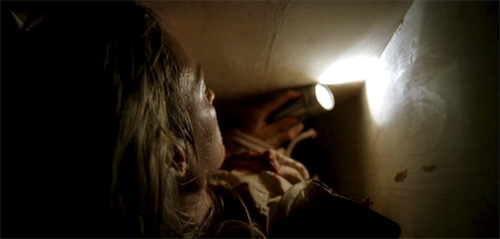 Characters. The use of characters are very important in the Thriller Genre. In this scene, we see two characters; The Bride and Bill. We see Bill first in a long distance shot of the location, with him walking towards his caravan. Straight away we judge him as a 'hillbilly' a 'trailer trash' character because we see that he lives in the middle of no where in a caravan. The close up of him confirms this as we see his dirty clothes, jewellery and greasy hair (stereotypical aspects of 'trailer trash') The other character we see is 'The Bride'. Played by Uma Thurman, the bride is seen as a fairly masculine femme fatale, not the typical glamourous Femme Fatale characters of the 1940's. She takes a very masculine role in the film, one typically played by men in most thrillers.
 Friday, 24 September 2010
Film Noir and femme fatale
Film noir:
a movie that is marked by a mood of pessimism, fatalism, menace, and cynical characters; "film noir was applied by French critics to describe American thriller or detective films in the 1940s"


a movie that is marked by a mood of pessimism, fatalism, menace, and cynical characters; "film noir was applied by French critics to describe American thriller or detective films in the 1940s"

Film noir is a cinematic term used primarily to describe stylish Hollywood crime dramas, particularly those that emphasize cynical attitudes and sexual motivations. Hollywood's classic film noir period is generally regarded as stretching from the early 1940s to the late 1950s. ..
Film noir is used to place the audience in the same position as the characters:
- Evil
- Uncertanty
- mystery, enigma
- suspense
- nightmare
femme Fatale:
A female character in a film that is considered 'dangerous' in a film, usually presented as glamorous and seductive. "deadly woman".

An example of A femme fatale is the Bride, from Kill Bill 2, however, she is seen as an untraditional Femme Fatale, a traditional example is Gilda.
Chiaroscuro Lighting is where you can only see certain features of face:
Extreme light on dark
- unreal looking
- asthetically pleasing
- non ambient (not natural- ambient is natural)

(images from Google)
Thursday, 9 September 2010
Subscribe to:
Posts (Atom)